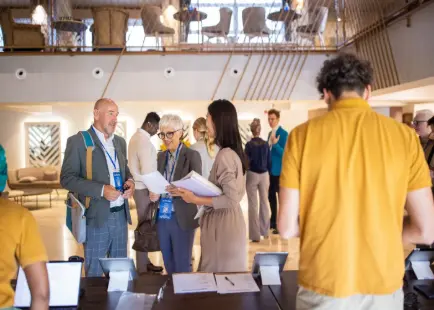
A booth usually has a few private rooms for customer meetings and demos. Each one holds one meeting at a time. When a meeting runs over or a VIP arrives early, the overrun ripples through the day and someone scrambles for an open room.
What is Event Resource Management?
Event Resource Management, or ERM for short, is how a vendor team keeps rooms, demo stations, team members, and customer meetings aligned at a trade show booth while the schedule keeps moving. Calendar tools manage time. Spreadsheets manage data. Event Resource Management is the part that manages the intersection of all four.
What it actually is.
It is the part of booth work no general tool was built for. The intersection itself.
Event organizer platforms run the conference itself. Registration, the agenda, the attendee app. That is a different job and a different buyer. Event Resource Management is what the exhibitor does inside its own booth footprint.
Picture yourself running the booth on day two of a three day event. It is 10am. You have seven meetings booked across three rooms. Two reps called in sick. A customer set for 11 wants to move to 2pm. Your sales lead just claimed the demo station for a trial that is running long. This is Event Resource Management in motion.
Manage any one of those four parts alone and it looks simple. Manage the intersection of all four, live, while the schedule changes hour by hour, and you have the real job.
The four things you are managing.
Every booth runs on four moving parts. Keeping them aligned is one job, not four.
A demo slot needs a rep, a laptop, and a customer. If the rep is booked in a meeting elsewhere, the station sits idle during peak floor traffic. The fix is reserving rep time so the same person is not double claimed.
You have a fixed number of people for each day and hour. The coverage grid is real. A shift gap leaves the booth understaffed at the exact moment a customer walks up expecting attention.
These are why the booth exists. Every meeting has to slot into a room, a demo station, and team availability without a collision. A meeting booked into a collision becomes a missed opportunity or a scramble.
Why your current tools miss it.
Most teams reach for a tool they already have. Each one solves a slice and stops.
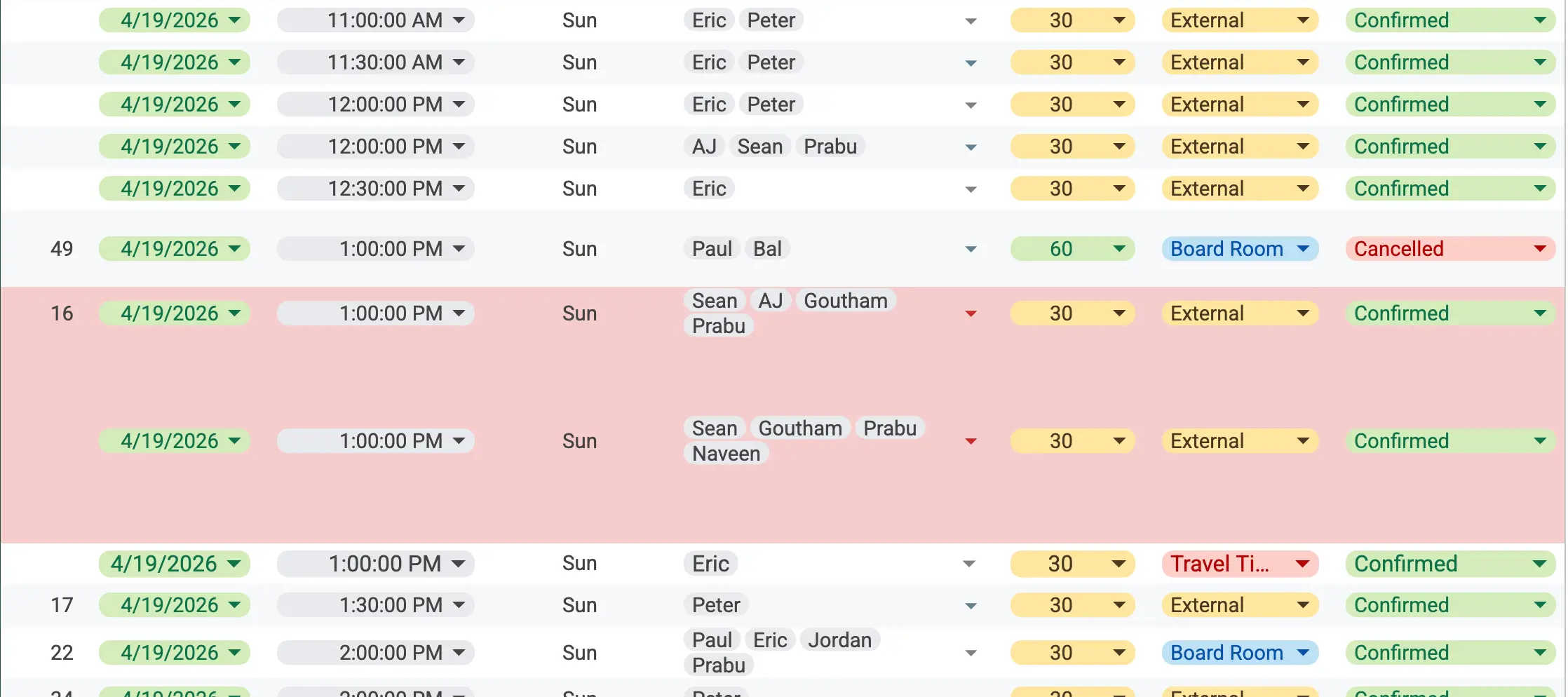
Each tab was one room.
Tracks time, not rooms.
A calendar like Outlook or Google Calendar shows who is booked when. It has no concept of a room. Double book a physical suite and the calendar does not know. Your team finds out when someone is already inside.
Books a meeting, not a booth.
A scheduler like Calendly stops one person from overlapping themselves. It has no idea what room the meeting is in, whether a demo station is staffed, or who is on shift. It solves the person problem, not the booth problem.
True until something moves.
A spreadsheet holds rooms, people, meetings, and slots. By Wednesday of a multi day show there are three versions in circulation. Conflicts surface too late. Nobody knows which tab is current.
The pattern repeats. Each tool is fine while nothing moves. The moment the schedule changes, none of them keeps reflecting reality.
Who owns Event Resource Management.
Usually one person carries it. The title varies. The responsibility does not.
Owns event presence end to end. Books the booth, designs the demo, builds the team rotation, and reconciles the meeting list.
Owns the meeting workflow and the handoff from a booth meeting into the CRM pipeline.
Runs customer meetings at industry shows and coordinates meeting density across reps.
Handles customer meetings at user conferences and product launches, often at VIP stakes.
Whatever the title, it is one real person with a real budget and a quarter on the line. When the show runs smoothly, few people notice. When the coordination breaks, everyone does.
Common questions
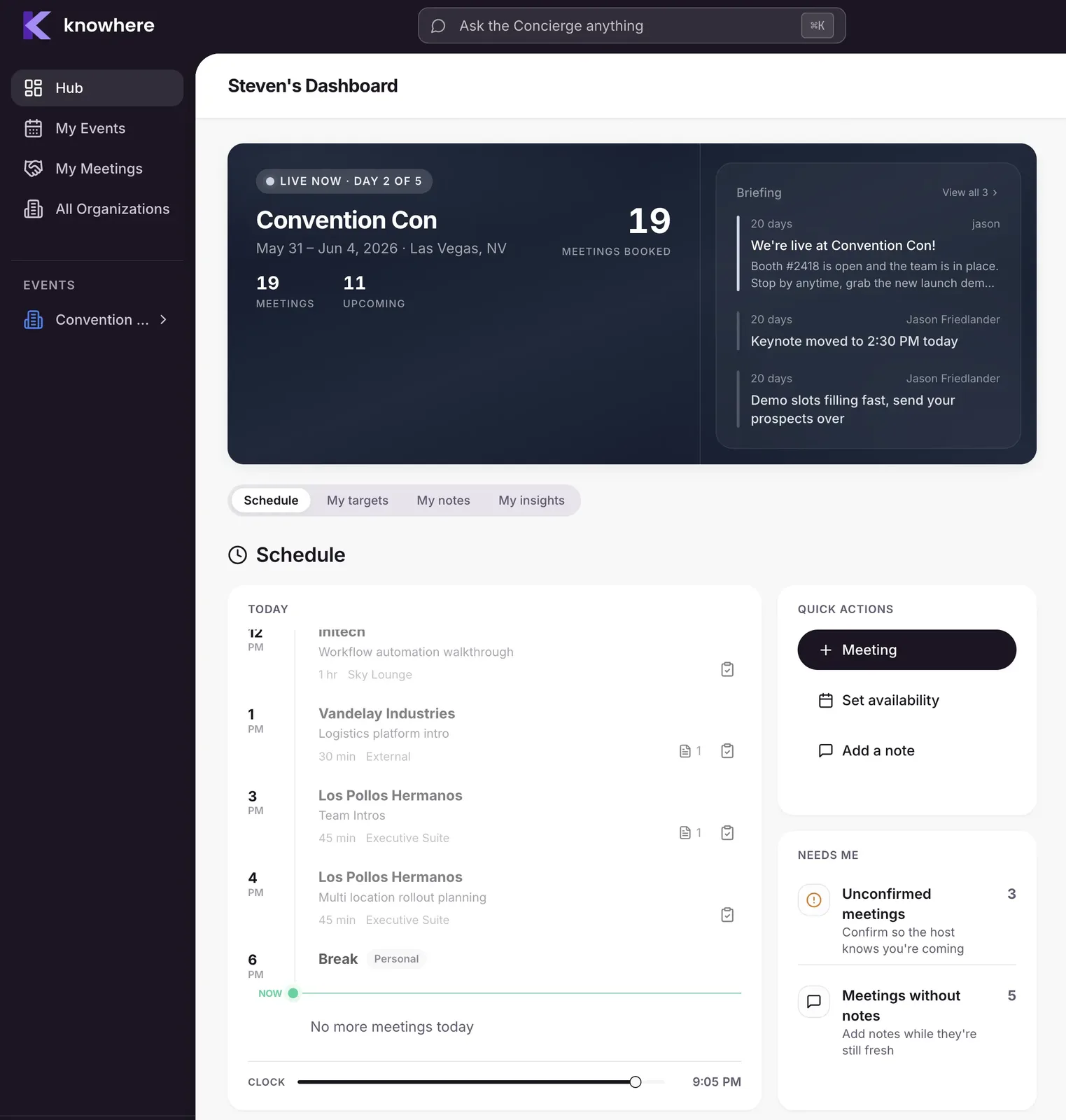
Knowhere is built for Event Resource Management.
Schedule rooms, demo stations, and team coverage all at once. See conflicts before they cost you a meeting. Read the pricing or see the full feature set.